

The topic came up in a recent office conversation. What started it I can’t fully remember, but looking at what’s happening in internet culture and tech world, in some awkward way, it totally lands.
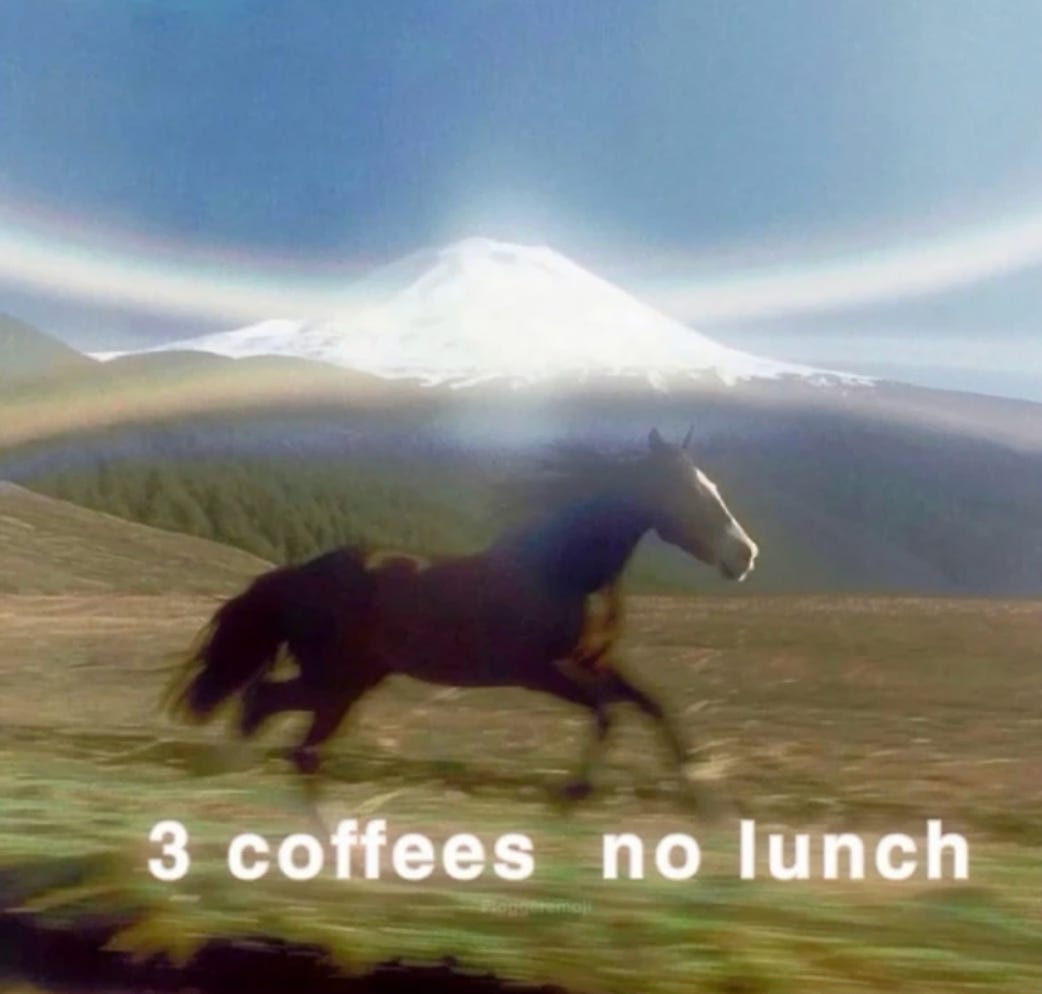
Exhibit A: Jacob’s infamous remixed 3 coffees no lunch horse. My ultimate mode visiting NYC. The world’s ultimate chase to accelerate shipping, the attention economy, the universal anxiety to simply keep up. Three coffees no lunch, in other words: a work animal.
Unit
The term “horsepower” was invented around 1782 by the Scottish engineer James Watt. The ultimate unit to measure up against machines originating hundreds of years ago. With the advent of the steam engine, Watt made a genius move to help the society comprehend the scale of new machinery and its impact, humanising in a way, something that might’ve felt foreign (kind of like naming a computer company Apple, or building the interface using a desktop, a folder, a trash can).
Fast-forward to 21st Century and we’re facing a new tectonic shift. This time horses are spared, but it’s our most humane part thats in question. Do we label it brainpower or mental power? (Yes, you know where I’m heading with this). Except this time, how do you even measure something so subjective? Or worse - maybe the thing we’d want to measure was never in the work to begin with.
Alas, that’s exactly what’s currently being measured. A recent BBC article talks about a study where readers couldn’t distinguish accurately AI vs human short stories. But the difficult truth was that among all, the AI stories also ranked higher, while people assumed they were written by a human.
Then there’s the case of infamous anonymous artist SHL0MS receiving pure rage in response to his AI generated Monet painting. Posting the image on X with “Made with AI” label, he asked people to explain, in detail, what made it inferior to a real Monet.
…only to later reveal it was an original Monet from Neue Pinakothek in Munich.


The two examples are inverted - machine measured as human, human work measured as machine’s. Both literature and art are subjective, and the intent matters because both make us feel something beyond a line of code or arithmetic. When the thing is measurable, it’s simple. But intent disappeared - no brushstroke to point at. Perhaps this is why the experiments worked - intent was never the question. So we’re not wrong that intent matters, but our radar of spotting it is not well equipped. We read the label and judgement becomes subjective.
Exhibit B
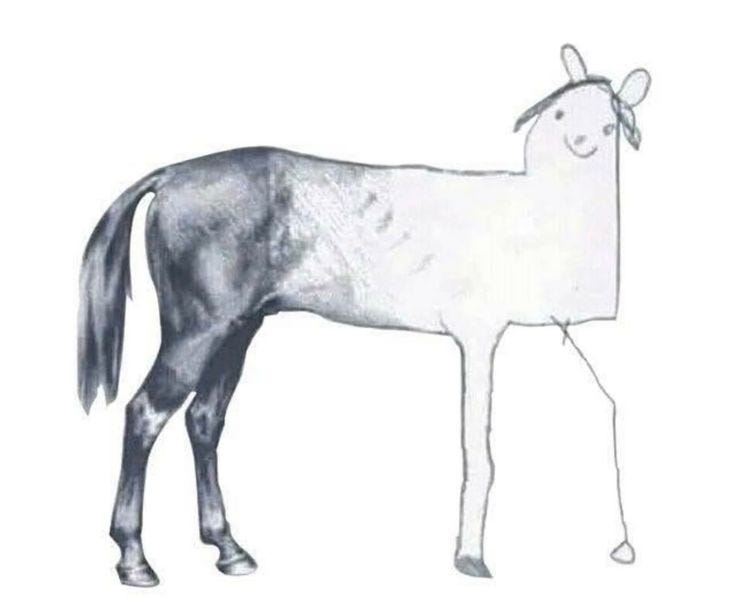
You know this one. Some meme it as “giving up half way” or promise vs deliverable. But somewhere along the way, the tables have turned. Imperfection is beginning to carry more value as it’s becoming the scarce artefact in a world where optimisation and efficiency dominate. And I know I keep circling the two: culture and the metric. I guess it’s because every one of these stories returns to this friction.
Watt could put a number on a horse because average power is measurable. What we’re trying to price now isn’t. Taste, intent, the reason one wobbly line lands and a perfect one doesn’t is that none of it survives being counted, and we’re counting it anyway. Benchmarks, percentiles, engagement, whether the thing renders at 16px.
Arithmetic always wins that fight, not because it’s right but because it’s the only one keeping score. (Funny enough it’s why I pursued technology and art, for the mystery of the immeasurable - an exploration to this day).
The flattening started without us
Kyle Chayka has been writing about this since well before any of the current wave. “Welcome to AirSpace” in 2016 was about why every coffee shop in every city arrived at the same reclaimed wood and Edison bulbs. Accelerated by Instagram and Yelp, not by a model. Filterworld built on it. His argument, roughly: flattening is what happens when creative work gets optimised for a distribution system.
The distribution system was social platforms long before we arrived here.
We didn’t lose personality to training data. We’d already converted it into training data long before the pursuit of creative training data has begun. Every startup is now sourcing access to original datasets: recruiting artists, accessing archives, scanning books. But what is all of that actually for? A machine gives back what it was given, a remix. Buying the archive doesn’t buy the thing that isn’t in the archive… unless the bet is computational creativity? (I’ll pause here as it’s late and that opens a can of worms for next episode)
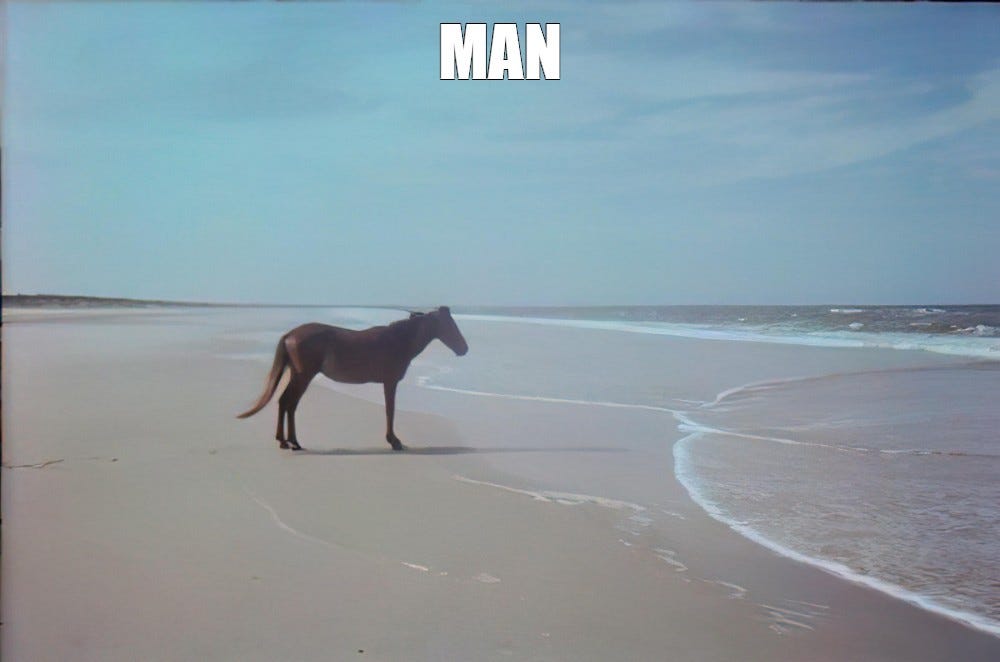
What actually happened to the horses?
The economist Wassily Leontief used horses as the argument that displacement can be permanent. The US horse population peaked somewhere around 26 million and fell off a cliff after the Model T. Horses had no retraining program.
But they didn’t disappear. There are still millions of them. They stopped being infrastructure and became something people do for love - ridden for pleasure, kept for beauty, expensive, unproductive, adored. The horse got promoted to art :)
Whether that reads as the consolation or the horror is really up to you, it’s definitely an opportunity to think through how the next decade shapes up. The knight came back to the logo. Serifs are back. Society is slowly in state of nostalgia and returning to appreciating the human mess. That’s either taste correcting itself, or scarcity pricing.
Three coffees, no lunch. Still keeping up.
__
Perhaps we live in a society that increasingly makes decisions through numbers, and we end up confusing what is measurable with what is truly valuable. Measurements give us the comforting illusion of objectivity...
for centuries humans were the resemblence of god, the the cogito ergo sum.
Now machines can cogito much better then the average person so who is the human?
the emotional ? the enraged ?
we are our own horses it seems